
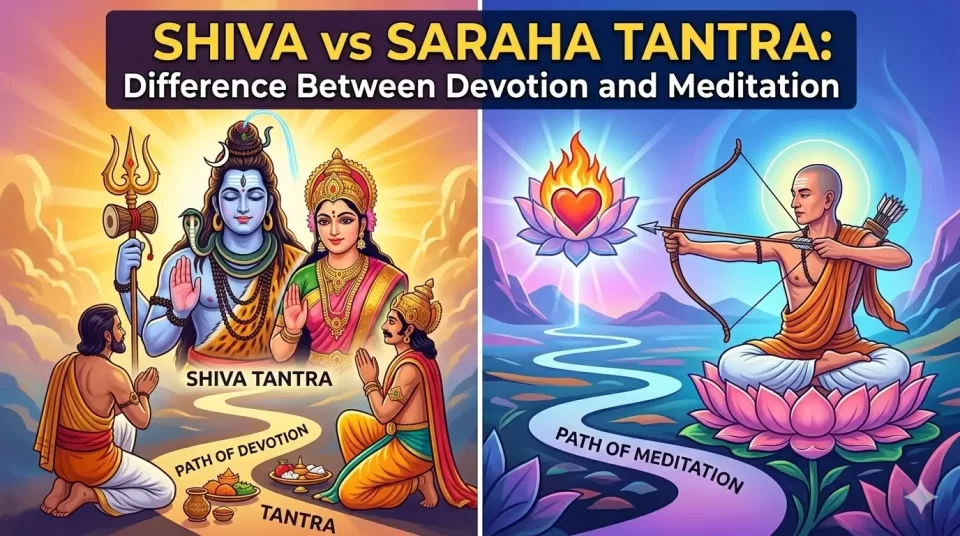
Shiva vs Saraha Tantra: What Is the Real Difference?
Shiva vs Saraha Tantra: What Is the Real Difference?
Is there any difference between Shiva’s approach to Tantra and Saraha’s approach?
Yes — in method.
No — in destination.
Both paths aim at ego dissolution. But one moves through love and devotion, and the other through meditation and awareness.
Let us go deeper.
The Two Core Paths in Tantra – Devotion and Meditation
All spiritual traditions ultimately fall into two categories:
- The Path of Devotion (Bhakti, Love, Surrender)
- The Path of Meditation (Awareness, Intelligence, Emptiness)
Shiva represents devotional Tantra.
Saraha represents meditative Tantra.
They are different doors into the same state of enlightenment.
Shiva’s Tantra – The Devotional Path of Love and Surrender
Shiva’s approach to Tantra is heart-centered.
It begins with relationship:
• The devotee (Bhakta)
• The divine (Bhagwan)
Love is the method.
But this love is not attachment. It is transformation.
Through devotion:
• Possessiveness dissolves
• Jealousy disappears
• Ego softens
• Love becomes universal
At the peak of Shiva’s Tantra, the lover and the beloved dissolve into one unity.
Enlightenment here feels like ecstatic union.
Saraha’s Tantra – The Meditative Path of Awareness and Emptiness
Saraha, rooted in Buddhist Tantra, takes a radically different approach.
He begins with awareness of thought.
Through meditation:
• Thoughts are observed
• Identity is questioned
• The ego is dismantled
• The mind becomes silent
When thinking dissolves completely, even “I” and “God” disappear.
What remains?
Shoonya — emptiness.
No lover.
No beloved.
Only pure awareness.
Enlightenment here feels like vast silence.
Devotion vs Meditation – Heart-Centered vs Mind-Centered Paths
The real difference between Shiva and Saraha’s Tantra is psychological.
Shiva transforms emotion.
Saraha transcends cognition.
Human beings tend to be either:
• Feeling-oriented (heart-dominant)
• Thinking-oriented (mind-dominant)
If relationship nourishes you, Shiva’s path resonates.
If solitude energizes you, Saraha’s path calls you.
Both lead to ego dissolution.
Do Shiva and Saraha Reach the Same Goal?
Yes.
Though their approaches differ, both paths aim at:
• Dissolution of ego
• End of personal identity
• Transcendence of self
• Enlightenment
In Shiva’s path, the ego dissolves in love.
In Saraha’s path, the ego dissolves in awareness.
Different journeys. Same disappearance.
Hindu Tantra vs Buddhist Tantra – What’s the Difference?
Hindu Tantra (Shiva tradition):
• Relational
• Devotional
• Love-centered
• Union with the divine
Buddhist Tantra (Saraha tradition):
• Non-relational
• Meditative
• Awareness-centered
• Realization of emptiness
One emphasizes divine union.
The other emphasizes emptiness.
Both transcend ego.
Which Tantra Path Is Right for You?
Ask yourself:
Can you be blissful alone?
If yes → Saraha’s meditative path may suit you.
Do you awaken emotionally in relationship?
If yes → Shiva’s devotional path may be natural for you.
Tantra is not about ideology.
It is about temperament.
Frequently Asked Questions About Shiva and Saraha Tantra
What is the main difference between Shiva and Saraha’s Tantra?
Shiva’s Tantra focuses on devotion and love as the path to enlightenment, while Saraha’s Tantra emphasizes meditation and awareness to dissolve the ego.
Is Shiva’s Tantra devotional?
Yes. Shiva’s Tantra is rooted in devotion (Bhakti), where the relationship between devotee and divine gradually dissolves into unity.
Is Saraha’s Tantra based on meditation?
Yes. Saraha’s approach is based on awareness and observation of thought, leading to realization of emptiness (Shoonya).
Do Shiva and Saraha teach different goals?
No. Both paths aim at ego dissolution and enlightenment, though they use different methods.
What is the difference between Hindu Tantra and Buddhist Tantra?
Hindu Tantra emphasizes devotional union with the divine, while Buddhist Tantra emphasizes awareness and emptiness.
