
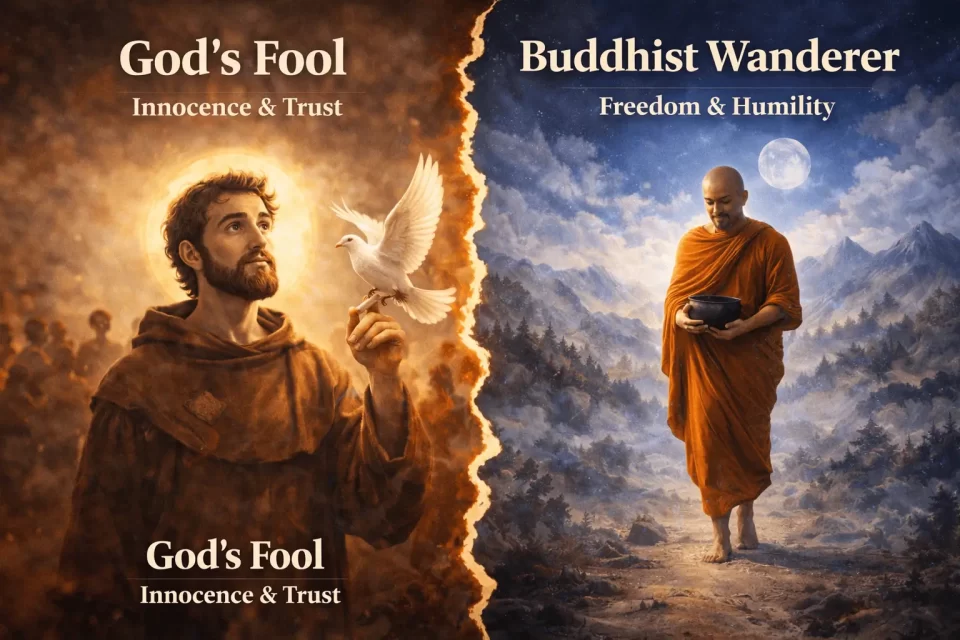
God’s Fool Meaning: The Wisdom Hidden in Innocence
Buddha told his monks:
Be wanderers.
Not just physically — but spiritually.
Do not settle before you awaken.
Do not pretend you have arrived.
Wander — inside and outside — until truth is not belief, but experience.
Only when you have attained can you sit.
Until then, keep moving.
Why Buddhist Monks Were Wanderers
The Buddhist bhikkhu was not meant to build an identity.
He was meant to dissolve it.
A wanderer has no fixed label, no ownership, no psychological comfort zone. Wandering breaks the illusion of security.
And security is the ego’s favorite addiction.
In American culture especially, stability is worshipped — career stability, relationship stability, financial stability.
But spiritually?
Stability can become stagnation.
Movement keeps you alive.
Wandering keeps you humble.
What Does “God’s Fool” Really Mean?
The phrase “God’s fool” does not mean stupidity.
It means innocence without ego.
Saint Francis was called God’s fool.
Why?
Because he did not claim knowledge.
He did not assert superiority.
He did not argue theology.
He trusted.
And in a world obsessed with proving itself right, trust looks foolish.
If you say, “I know,” people resist.
If you say, “I don’t know,” they immediately agree.
Ego demands recognition.
Wisdom does not.
That is the paradox.
Innocence vs Ignorance — What’s the Difference?
Ignorance and wisdom share one strange quality:
Neither is cunning.
The ignorant person doesn’t know.
The enlightened person doesn’t pretend to know.
Both appear simple.
But the scholar?
The intellectual?
The word-collector?
He is tired.
Because he is constantly defending his knowledge.
Working with words exhausts you.
Working with life energizes you.
Why Scholars Are Always Tired
Go to any academic conference.
You will see exhaustion disguised as authority.
So much thinking.
So much arguing.
So much proving.
But where is the freshness?
A fool is fresh.
A saint is fresh.
Both are not carrying the burden of “I know.”
The scholar carries libraries in his head — and libraries are heavy.
Silence threatens him.
Because his entire power exists in language.
Take away his words — and he is naked.
Silence vs Intellect — Who Wins?
There is a Zen story.
A learned traveler comes to debate.
The elder monk knows his younger brother is simple — almost foolish.
He says: “Debate in silence.”
The traveler agrees.
Soon he returns and says, “Your brother is extraordinary.”
What happened?
The learned man lost.
Because without words, his weapon disappeared.
The fool remained silent.
Silence can defeat intellect.
Because intellect depends on noise.
Truth does not.
The Power of Trust — Even When You Are Deceived
Here is where Americans struggle most.
Trust.
If someone deceives you once, you stop trusting everyone.
You generalize.
“This world is corrupt.”
“No one can be trusted.”
But look carefully.
Did you really want to trust from the beginning?
Or were you waiting for an excuse?
A trusting person says:
“This man failed. But life moves. People change.”
Life is dynamic.
Sinners become saints.
Saints become sinners.
The river flows.
To close your heart permanently because of one betrayal is not intelligence.
It is fear disguised as wisdom.
Comfort vs Aliveness — A Brutal Choice
Trust is risky.
You may lose money.
You may be deceived.
But what is greater?
Losing money?
Or losing your capacity to trust?
Money gives comfort.
Trust gives celebration.
A comfortable life can become a comfortable death.
But a trusting life burns bright.
Maybe only for moments.
But those moments are real.
Why the Cunning Mind Cannot Relax
The cunning mind calculates constantly.
It expects betrayal.
It anticipates loss.
It prepares defenses.
It calls this intelligence.
But this is exhaustion.
The innocent person rests.
Not because he is naive.
But because he is not obsessed with control.
The Real Strength of Innocence
Innocence is not weakness.
It is freedom from manipulation.
You can exploit an innocent person.
But you cannot destroy their trust.
And that is power.
The ego fears looking foolish.
But enlightenment often looks foolish to the calculating mind.
That is why mystics are misunderstood.
That is why saints are called naive.
That is why truth rarely looks impressive.
Final Insight — Wander Until You Are Real
Do not settle for borrowed knowledge.
Do not pretend certainty.
Wander.
Trust.
Remain innocent.
Be willing to look like a fool in a world addicted to appearing intelligent.
Because the ego wants to win arguments.
But the awakened one wants to disappear.
And when the ego disappears —
Wisdom remains.
FAQ Section
What does “God’s fool” mean?
God’s fool refers to a spiritually innocent person who does not claim knowledge or superiority but lives with trust and humility.
Why were Buddhist monks wanderers?
Buddhist monks wandered to avoid attachment and ego-identity, cultivating humility and direct experience rather than fixed beliefs.
Is innocence the same as ignorance?
No. Ignorance lacks awareness, while spiritual innocence comes from transcending ego and knowledge.
Why do scholars struggle with silence?
Scholars rely on words and intellect for identity. Silence removes their primary tool, exposing insecurity.
Is trust foolish?
Trust can lead to vulnerability, but it also allows deep aliveness and connection. Losing trust may protect comfort but reduces vitality.
