
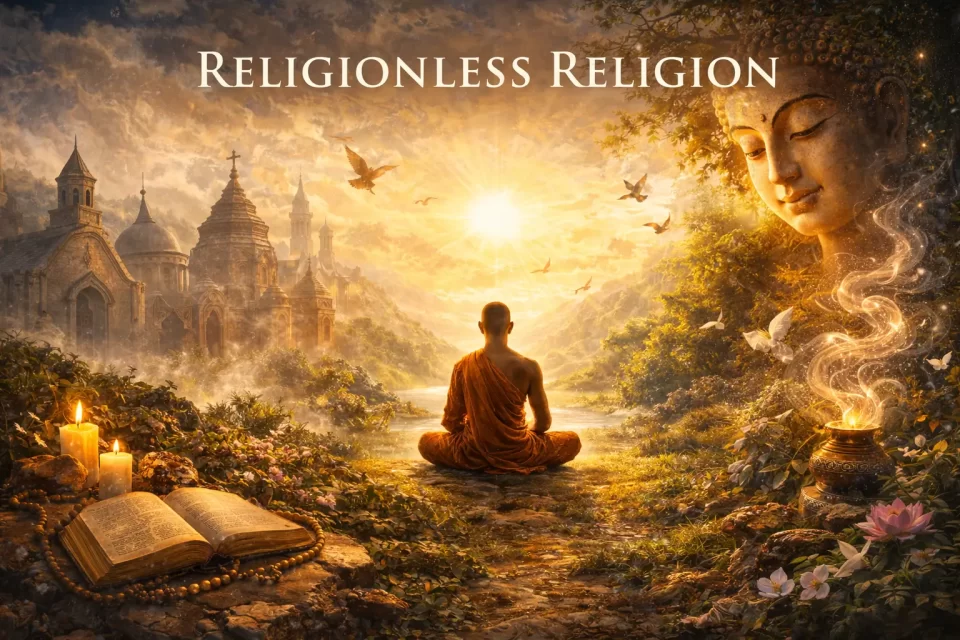
The Religionless Religion: Beyond Belief, Into Pure Religiousness
The Founder of a Religionless Religion
There have been many founders of religions.
Jesus founded Christianity.
Muhammad founded Islam.
Mahavira founded Jainism.
But Buddha did something radically different.
He did not found a religion.
He created what can only be called a religionless religion.
He did not preach religion.
He preached religiousness.
And there is a tremendous difference between the two.
Religion is organized.
Religiousness is alive.
Religion belongs to institutions.
Religiousness belongs to consciousness.
The Problem With Organized Religion
Look at what religion has become in the world.
Temples.
Churches.
Mosques.
Rituals.
Dogmas.
Beliefs.
Religion has become an institution.
And institutions are dead things.
They preserve the past.
They repeat old formulas.
They protect traditions.
But truth is not traditional.
Truth is always fresh.
Truth is always alive.
That is why Buddha avoided creating another rigid religion.
He knew what happens when truth becomes organized.
It dies.
Religion Is Structure, Religiousness Is Experience
Religion is something you inherit.
Religiousness is something you discover.
You can be born into Christianity.
You can be born into Islam.
You can be born into Hinduism.
But you cannot be born into religiousness.
Religiousness is not a belief.
It is a state of awareness.
It arises when your mind becomes silent.
When your heart becomes open.
When your consciousness becomes alert.
Religion tells you what to believe.
Religiousness asks you to observe.
Buddha’s Radical Vision
Buddha was revolutionary.
He removed all unnecessary layers from spirituality.
No gods.
No rituals.
No priesthood.
No blind belief.
Instead he offered something very simple:
Awareness.
Watch your breath.
Observe your thoughts.
Become conscious of your actions.
Through awareness, ignorance dissolves.
Through awareness, suffering disappears.
This was Buddha’s entire teaching.
Religiousness Is an Inner Quality
Religiousness is not about temples.
It is about presence.
It is not about scriptures.
It is about awareness.
A religious person is not someone who follows a doctrine.
A religious person is someone who lives consciously.
He eats consciously.
He walks consciously.
He speaks consciously.
Every moment becomes meditation.
That is religiousness.
Why Religions Resist Religiousness
This may sound strange, but organized religions often fear true religiousness.
Why?
Because religiousness does not need intermediaries.
If people become aware, priests become unnecessary.
If people experience truth directly, scriptures lose authority.
Institutions survive only when individuals remain dependent.
Religiousness creates independence.
That is why mystics have often been misunderstood.
The Difference Between Belief and Awareness
Belief is borrowed.
Awareness is discovered.
Belief belongs to the mind.
Awareness belongs to consciousness.
A believer may know many scriptures.
But a religious person knows silence.
Belief can create argument.
Awareness creates understanding.
Belief divides people.
Awareness unites them.
Religiousness in Everyday Life
Religiousness does not require monasteries.
It does not require rituals.
It does not require isolation from life.
It can exist in ordinary moments.
Drinking tea.
Walking in nature.
Watching the sunset.
Listening to silence.
When you are fully present in these moments, you are religious.
Not because you follow a religion.
But because you are alive to existence.
The Danger of Turning Religiousness Into Religion
History shows a strange pattern.
Every great mystic begins with religiousness.
After his death, followers create religion.
Buddha taught awareness.
Followers created Buddhism.
Jesus taught love.
Followers created Christianity.
The same danger exists everywhere.
Living truth becomes dead doctrine.
The flame becomes an institution.
The Real Temple Is Consciousness
The true temple is not made of stone.
It is made of awareness.
The true prayer is not spoken.
It is lived.
When consciousness becomes clear, life itself becomes sacred.
The wind becomes a prayer.
The silence becomes meditation.
The entire existence becomes divine.
This is the essence of religionless religion.
The Future of Spirituality
The future of spirituality will not belong to organized religion.
It will belong to awareness.
People are becoming more intelligent.
More questioning.
More curious.
Blind belief is slowly disappearing.
What will replace it is direct experience.
Meditation.
Self-awareness.
Inner exploration.
This is the new spirituality.
FAQ – Religionless Religion and Religiousness
What is a religionless religion?
A religionless religion refers to spirituality based on direct awareness rather than organized beliefs or institutions.
What is the difference between religion and religiousness?
Religion involves structured beliefs and rituals, while religiousness is an inner state of awareness and consciousness.
Did Buddha create a religionless religion?
Buddha emphasized awareness and meditation rather than dogma, which many interpret as a religionless approach to spirituality.
Can someone be spiritual without religion?
Yes. Many spiritual traditions emphasize direct experience and awareness rather than organized religion.
Why do mystics criticize organized religion?
Mystics often believe that institutional religion can replace direct spiritual experience with rigid beliefs and traditions.
Conclusion: From Religion to Religiousness
Religion divides the world.
Religiousness unites it.
Religion creates identities.
Religiousness dissolves them.
Religion lives in temples.
Religiousness lives in awareness.
The true spiritual revolution is not about creating new religions.
It is about awakening religiousness within each human being.
And when that happens, life itself becomes sacred.
No temple needed.
No priest needed.
Only awareness.
