
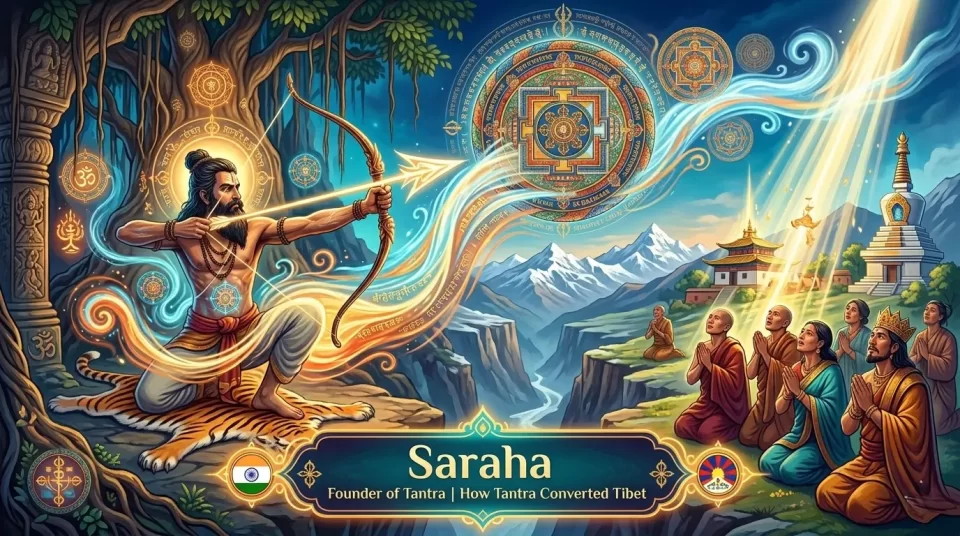
Saraha: The Founder of Tantra — Just as Bodhidharma Is the Founder of Zen
Was Saraha the Founder of Tantra?
Yes — Saraha is regarded as the founder of Tantra in the same way Bodhidharma is regarded as the founder of Zen.
But understand this carefully.
Founders in spirituality do not invent truth.
They ignite it.
Saraha did not create Tantra.
He exploded it into consciousness.
Just as Bodhidharma carried the flame of meditation to China and ignited Zen, Saraha carried the fire of direct experience that later transformed Tibet into a tantric civilization.
Tantra Converted Tibet — Not Through Argument, But Through Experience
Tantra did not conquer Tibet with swords.
It conquered through intensity.
Through direct methods.
Through shocking clarity.
Tibet was not converted by theology.
It was transformed by experience.
Tantra is not belief.
Tantra is technique.
It does not say “believe in enlightenment.”
It says “experience it.”
And Saraha was the rebel mystic who embodied that spirit.
Who Was Saraha?
Saraha was not a priest.
He was not a scholar in the conventional sense.
He was a revolutionary mystic.
According to legend, he was once a learned monk — highly respected, intellectually sharp. But something inside him remained incomplete.
Knowledge was there.
Wisdom was not.
And one day, it is said, he encountered a simple arrow-making woman — uneducated, ordinary, grounded in life.
She shattered his scholarship.
Why?
Because she was present.
While Saraha was filled with scriptures, she was filled with awareness.
That moment became the turning point.
He dropped borrowed knowledge.
He entered direct experience.
And from that fire, Tantra emerged in its purest form.
Saraha and the Origins of Tibetan Tantra
Tantra in Tibet — later known as Vajrayana Buddhism — owes its living energy to Saraha.
He emphasized:
• Direct realization
• Spontaneity
• Inner alchemy
• Transformation of desire
• Emptiness with intensity
Unlike dry philosophy, Saraha’s teachings were experiential.
He sang his wisdom.
His Dohas — spontaneous songs of realization — were not theological treatises.
They were explosions.
In these songs, he mocked scholars.
He laughed at ritualism.
He attacked spiritual hypocrisy.
He pointed again and again to immediate awareness.
That is Tantra.
Saraha vs Traditional Buddhism
Classical Buddhism emphasized renunciation.
Discipline.
Meditation.
Gradual progress.
Tantra said:
Use everything.
Desire is not the enemy.
Energy is not the enemy.
The body is not the enemy.
Nothing needs to be rejected — only transformed.
This radical inclusion shocked conservative monks.
But it electrified Tibet.
Because Tantra is dynamic.
Alive.
Raw.
And human beings are drawn to intensity.
Why Saraha Is to Tantra What Bodhidharma Is to Zen
Bodhidharma brought meditation beyond scripture.
He emphasized direct transmission outside words.
Saraha did the same in Tantra.
Both were anti-intellectual in the deepest sense.
Not against intelligence.
But against borrowed knowledge.
Bodhidharma sat facing a wall for nine years.
Saraha sang songs in marketplaces.
Different expressions.
Same essence.
Direct realization.
No compromise.
No ritualistic dependence.
No priestly authority.
Tantra Is Not About Ritual — It Is About Awakening
Modern misunderstandings reduce Tantra to sexuality.
This is ignorance.
Tantra is about total acceptance of energy.
Sexuality is only one expression.
Anger can become awareness.
Desire can become meditation.
Fear can become presence.
Tantra says nothing needs suppression.
Everything needs consciousness.
Saraha lived this.
He did not preach morality.
He preached awareness.
And awareness transforms automatically.
Why Tibet Was Ready for Tantra
Tibet was wild.
Raw.
Untamed.
Unlike highly structured civilizations, Tibet had space for mystical experimentation.
Tantra thrives where life is intense.
Tantra cannot survive in overly polished environments.
It needs rawness.
And Tibet embraced it.
Not as theory.
But as practice.
Monasteries became centers of inner alchemy.
Meditation techniques became fierce.
Visualization practices became powerful.
Mantras became living vibrations.
This was Saraha’s influence — directly or indirectly.
Saraha’s Dohas: Wisdom Without Ornament
Saraha did not write academic commentaries.
He sang.
His Dohas speak of:
• Emptiness
• Non-duality
• Spontaneity
• The futility of ritual
• The illusion of ego
He laughed at priests.
He laughed at scholars.
Because truth does not belong to language.
Truth is immediate.
He declared:
Why search in scriptures when awareness is here?
Why seek outside when consciousness is within?
This is the heart of Tantra.
Tantra vs Religion
Religion depends on belief.
Tantra depends on transformation.
Religion creates systems.
Tantra destroys systems.
Religion builds institutions.
Tantra breaks boundaries.
This is why Tantra has always been controversial.
And this is why Saraha is revolutionary.
He did not found a religion.
He ignited a movement of consciousness.
The Psychology Behind Tantric Transformation
Modern psychology is slowly discovering what Tantra always knew.
Energy suppressed becomes neurosis.
Energy witnessed becomes liberation.
Tantra does not fight desire.
It watches it.
It does not suppress anger.
It transforms it through awareness.
This is inner alchemy.
When awareness penetrates instinct, instinct becomes luminous.
That is Vajrayana — the Diamond Vehicle.
Unbreakable.
Clear.
Radiant.
Saraha’s Relevance Today
In a world obsessed with information, Saraha is necessary.
Because knowledge is overflowing.
Wisdom is rare.
People read endlessly.
Scroll endlessly.
Consume endlessly.
But rarely experience directly.
Tantra says:
Stop collecting.
Start witnessing.
Stop analyzing.
Start being present.
That is rebirth.
That is awakening.
Why Tantra Is Misunderstood in the West
In the West, Tantra is often marketed as exotic sexuality.
This is superficial.
Tantra is existential.
It includes sexuality — but transcends it.
It is about totality.
Body and consciousness united.
Matter and spirit united.
Emptiness and energy united.
Saraha embodied this union.
Bodhidharma and Saraha: Two Flames of Direct Experience
Bodhidharma emphasized:
Sit silently.
Witness thoughts.
Drop mind.
Saraha emphasized:
Live intensely.
Witness energy.
Transform mind.
One leans toward stillness.
The other toward aliveness.
Both arrive at emptiness.
Both reject second-hand knowledge.
Both destroy spiritual pretension.
Both demand authenticity.
The Real Meaning of Founder
When we say Saraha is the founder of Tantra, we do not mean he invented truth.
Truth cannot be invented.
We mean he articulated it.
Embodied it.
Ignited it in collective consciousness.
A founder in spirituality is a catalytic presence.
And Saraha was catalytic.
Tantra Converted Tibet — But It Converts Individually
Tantra does not convert nations.
It converts individuals.
It transforms consciousness.
If enough individuals awaken, culture shifts.
Tibet became tantric not by decree.
But by depth of practice.
By transmission from master to disciple.
By lived experience.
The Danger and Beauty of Tantra
Tantra is powerful.
Because it deals with raw energy.
Without awareness, energy destroys.
With awareness, energy liberates.
That is why Tantra requires maturity.
It is not for the curious.
It is for the committed.
Saraha was uncompromising.
He demanded authenticity.
He demanded presence.
He demanded courage.
What Can We Learn from Saraha Today?
In a modern world:
Overstimulated.
Overanalyzed.
Over-educated.
Saraha whispers:
Drop it.
Be simple.
Be aware.
Be immediate.
Stop seeking outside validation.
Stop clinging to intellectual superiority.
Awaken through direct experience.
FAQ – Saraha and the Origins of Tantra
Was Saraha really the founder of Tantra?
Saraha is considered one of the earliest and most influential tantric masters, especially in the development of Tibetan Vajrayana Buddhism.
How did Tantra influence Tibet?
Tantra transformed Tibetan Buddhism by emphasizing direct experience, energy transformation, and esoteric meditation techniques.
What is the difference between Tantra and Zen?
Zen emphasizes silent meditation and direct awareness. Tantra emphasizes transformation of energy and total acceptance of life’s forces.
Is Tantra only about sexuality?
No. Tantra is about consciousness and energy transformation. Sexuality is only one aspect of human energy.
Why is Saraha important in Buddhist history?
Saraha helped establish the experiential and radical foundation of Vajrayana Buddhism, influencing Tibetan spiritual traditions deeply.
Conclusion: The Fire That Still Burns
Saraha’s flame has not died.
It burns wherever someone dares to experience directly.
It burns wherever someone drops borrowed knowledge.
It burns wherever awareness touches raw energy.
Tantra converted Tibet.
But its real work is here.
In you.
If you are ready to experience rather than believe.
If you are ready to transform rather than imitate.
Then Saraha is alive.
Not in history.
But in consciousness.
