
Zen Argument Story Meaning: Priests, Intellectual Ego, and the Power of Simplicity
There is an old Zen tradition:
If a wandering monk can win an argument about Buddhism with one of the resident monks, they may stay the night.
If not, they must move on.
Look carefully.
Arguments can give you shelter — perhaps a night’s rest.
But that is all.
They rarely give awakening.
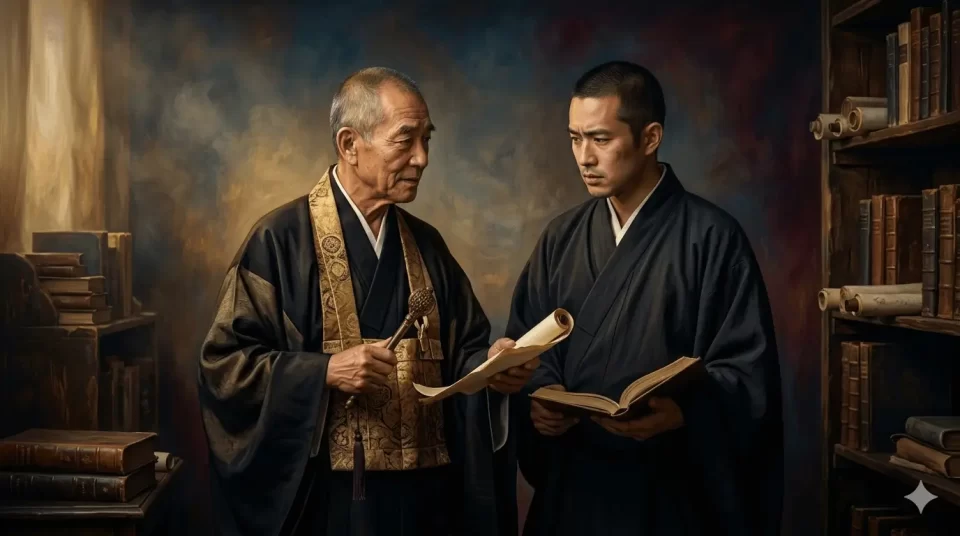
The Temple and the Two Brothers
In northern Japan, there was such a temple run by two brothers.
The elder brother was highly educated in Buddhist philosophy.
The younger brother was simple, untrained in scriptures — and he had only one eye.
Zen stories are never accidental.
They are mirrors.
Two types of personalities often exist in religious institutions:
Those who analyze.
And those who follow.
Institutions tend to survive on this dynamic.
Where there is hierarchy, there must be experts — and there must be believers.
Where there are interpreters, there must be those who depend on interpretation.
This duality sustains structure.
But truth itself is not divided.
Why Spiritual Institutions Create Distance
Many religious systems rely on complexity.
Special language.
Sacred terminology.
Elaborate doctrines.
When language becomes inaccessible, authority increases.
When something is difficult to understand, we often assume it must be profound.
But clarity is not the enemy of depth.
Buddha spoke in Pali — the language of ordinary people.
Jesus spoke in parables anyone could understand.
Mahavira used simple dialects rather than elite language.
They did not create distance.
They created direct access.
When spirituality becomes too technical, it risks becoming exclusive.
And when access is controlled, power concentrates.
The Symbolism of the One-Eyed Monk
Why was the younger monk one-eyed?
Symbolism.
A highly intellectual mind sees multiple angles.
It debates internally.
It questions constantly.
It is divided.
A simple mind is unified.
Not necessarily wise — but not internally conflicted.
The fool and the sage sometimes appear similar.
Both can seem simple.
But the difference is awareness.
The unaware person is simple because they do not know.
The awakened person is simple because they have gone beyond the need to prove.
The intellectual often stands in between — informed but restless.
Ignorance, Knowledge, and Wisdom
Ignorance can have innocence.
Wisdom can have innocence.
The tension lies in partial knowledge.
When someone believes they know — but are still uncertain inside — tension arises.
The ego must defend its position.
Constantly.
That is exhausting.
An unaware person rests in unconscious simplicity.
An awakened person rests in conscious simplicity.
The overthinker lives in tension.
Why Intellectual Debate Cannot Produce Awakening
In the Zen story, the elder brother instructs the younger:
“Debate in silence.”
The traveler returns impressed.
Why?
Because argument depends on language.
When words disappear, performance disappears.
And when performance disappears, only presence remains.
Many people today are skilled at explaining spirituality.
Few are skilled at embodying it.
Explanation wins applause.
Presence creates transformation.
Modern Spiritual Culture and Performance
In contemporary culture — especially in the West — spirituality can become intellectualized.
Podcasts. Certifications. Online debates. Terminology.
Information is abundant.
But information is not realization.
You can argue about mindfulness.
You can debate non-duality.
You can analyze enlightenment.
But none of that guarantees inner clarity.
Arguments may win social approval.
They do not dissolve ego.
The Wanderer as a Symbol of the Seeker
The wandering monk represents the seeker.
Not ignorant.
Not enlightened.
Searching.
In transition.
Arguments may earn temporary validation.
But awakening requires something deeper than intellectual victory.
It requires inner silence.
Why Simplicity Feels Threatening
When someone speaks simply, without jargon, it can feel unsettling.
There is no complexity to hide behind.
No terminology to impress with.
Simplicity removes barriers.
And when barriers fall, direct seeing becomes possible.
Institutions thrive on complexity.
Awakening thrives on clarity.
The Real Meaning of the Zen Temple Story
This story is not mocking education.
It is exposing identification.
When knowledge becomes ego, spirituality becomes competition.
When knowledge becomes humility, it becomes wisdom.
Winning arguments may grant temporary shelter.
But only self-awareness grants freedom.
Three States of Being
There are three stages:
Unaware simplicity.
Intellectual complexity.
Conscious simplicity.
The first is unconscious.
The second is divided.
The third is integrated.
The fool and the sage may look alike from the outside.
But one sleeps.
The other is awake.
The intellectual often stands between them — full of concepts, but longing for rest.
The Final Question
Where do you stand?
Are you defending ideas?
Are you collecting knowledge?
Or are you willing to become simple again — not naive, but clear?
Arguments may give you shelter for the night.
But silence may give you yourself.
And that is home.
FAQ Section
What is the meaning of the Zen argument story?
The story illustrates the limits of intellectual debate in spiritual growth and emphasizes simplicity and direct experience over theological competition.
What does the one-eyed monk symbolize?
The one eye symbolizes unity and inner integration, contrasting with the divided nature of over-intellectualization.
Why did Buddha avoid elite religious language?
Buddha used common language so spiritual teachings could remain accessible rather than restricted to religious authorities.
Can intellectual knowledge lead to enlightenment?
Knowledge can support understanding, but awakening requires inner awareness beyond conceptual debate.
Why do institutions rely on complexity?
Complexity can create authority and hierarchy, while simplicity promotes direct personal insight.
