
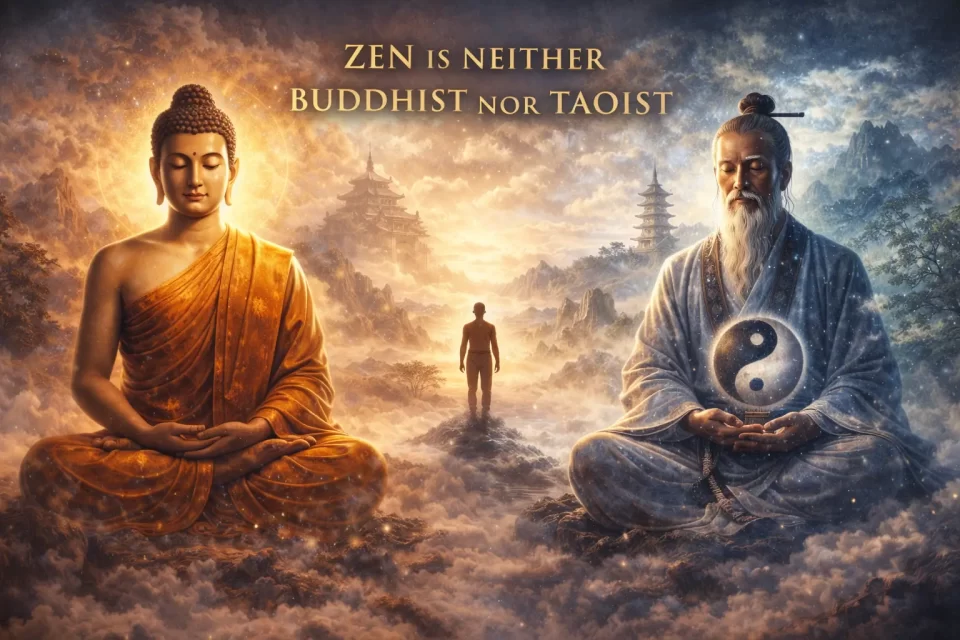
Zen Is Neither Buddhist Nor Taoist — And Yet It Is Both
What Is Zen Really?
People love labels.
They want to categorize everything.
Is Zen Buddhist?
Is Zen Taoist?
Is Zen a religion?
But Zen laughs at such questions.
Zen is neither Buddhist nor Taoist — and yet it contains the fragrance of both.
Zen is like the wind moving through two forests.
It carries the scent of both trees, but it belongs to neither.
The Birth of Zen: A Meeting of Two Worlds
Zen was born when two great streams of wisdom met.
From India came Buddhism, carrying the insight of Buddha — awareness, meditation, silence.
From China came Taoism, carrying the wisdom of Lao Tzu and Chuang Tzu — naturalness, spontaneity, effortless living.
When Buddhism entered China, something magical happened.
It encountered Taoism.
And the meeting was not a conflict.
It was a fusion.
Buddhist meditation merged with Taoist naturalness.
The result was Zen.
Buddhism: The Discipline of Awareness
Buddha’s teaching was deeply scientific.
He taught observation.
Watch the breath.
Watch the mind.
Watch sensations.
His approach was systematic.
Almost like a spiritual psychology.
Through awareness, the illusion of the ego dissolves.
Through meditation, suffering disappears.
This discipline formed the backbone of Zen.
But Zen added something new.
Taoism: The Beauty of Effortless Living
Taoism had a completely different flavor.
Lao Tzu and Chuang Tzu laughed at rigid discipline.
They emphasized wu wei — effortless action.
Do not force life.
Flow with life.
Be like water.
Water never fights, yet it reaches everywhere.
This relaxed wisdom softened the strict structure of Buddhism.
Zen absorbed this spirit completely.
Zen: The Marriage of Meditation and Naturalness
Zen is the perfect marriage.
From Buddhism it took meditation.
From Taoism it took spontaneity.
From Buddhism it took awareness.
From Taoism it took playfulness.
The result is a tradition that refuses to become a religion.
Zen masters rarely talk about doctrine.
They prefer silence.
Or a sudden shout.
Or an unexpected laugh.
Because truth cannot be explained.
It must be experienced.
Why Zen Rejects Labels
Zen masters are notorious for rejecting labels.
Ask a Zen master if Zen is Buddhist, and he may laugh.
Ask him if Zen is Taoist, and he may pour tea instead of answering.
Why?
Because Zen points directly to experience.
Labels belong to the mind.
Zen belongs to awareness.
Once you experience silence, categories disappear.
The Radical Simplicity of Zen
Zen is incredibly simple.
Sit silently.
Observe the mind.
Watch thoughts come and go.
Nothing needs to be suppressed.
Nothing needs to be controlled.
Just watch.
This simple practice dissolves the illusion of the self.
And when the self disappears, reality reveals itself.
Zen Is Not a Religion
Religion often depends on belief.
Zen depends on experience.
Religion asks you to believe.
Zen asks you to observe.
Religion gives answers.
Zen destroys questions.
Zen does not promise heaven.
Zen shows you the miracle of this moment.
Zen and Everyday Life
One of the most beautiful aspects of Zen is its simplicity.
Zen is not confined to temples.
Zen is in ordinary life.
Drinking tea.
Walking.
Cooking.
Listening to the rain.
Every act can become meditation.
Because Zen is not something you practice occasionally.
It is a way of living.
The Zen Mind: Beginner’s Mind
Zen emphasizes something called beginner’s mind.
A mind free from assumptions.
Free from conclusions.
Open.
Curious.
Children naturally have beginner’s minds.
But adults accumulate knowledge.
And knowledge becomes a barrier.
Zen dissolves this barrier.
So you can see reality freshly again.
Why Zen Feels So Modern
Zen feels surprisingly modern.
Because it avoids unnecessary philosophy.
It avoids complex theology.
It focuses on direct experience.
Modern psychology now confirms many Zen insights:
• Awareness reduces stress
• Mindfulness increases clarity
• Presence improves emotional well-being
Zen discovered these truths centuries ago.
Zen Is a Living Experience
Zen cannot be understood intellectually.
You can read a thousand books about Zen.
But unless you experience silence directly, Zen remains a mystery.
It is like reading about swimming.
You may understand the theory.
But until you enter the water, you cannot swim.
Zen invites you into the water.
FAQ – Zen, Buddhism, and Taoism
Is Zen Buddhism or Taoism?
Zen developed from the meeting of Buddhism and Taoism, combining Buddhist meditation with Taoist naturalness.
What makes Zen different from other religions?
Zen focuses on direct experience rather than belief, doctrine, or theology.
Who founded Zen?
Zen originated with Bodhidharma, an Indian monk who brought Buddhist meditation to China.
What is the main practice in Zen?
The central practice is meditation (zazen), which involves sitting silently and observing the mind.
Why is Zen so simple?
Zen removes unnecessary philosophy and points directly to awareness and experience.
Conclusion: The Silent Bridge Between Two Traditions
Zen is a bridge.
A bridge between Buddha and Lao Tzu.
Between discipline and spontaneity.
Between meditation and natural living.
It carries the fragrance of both traditions.
Yet it belongs to neither.
Because Zen is not a doctrine.
Zen is an experience.
And once you taste it, you understand why the masters say:
Zen is neither Buddhist nor Taoist — and yet it is both.
