
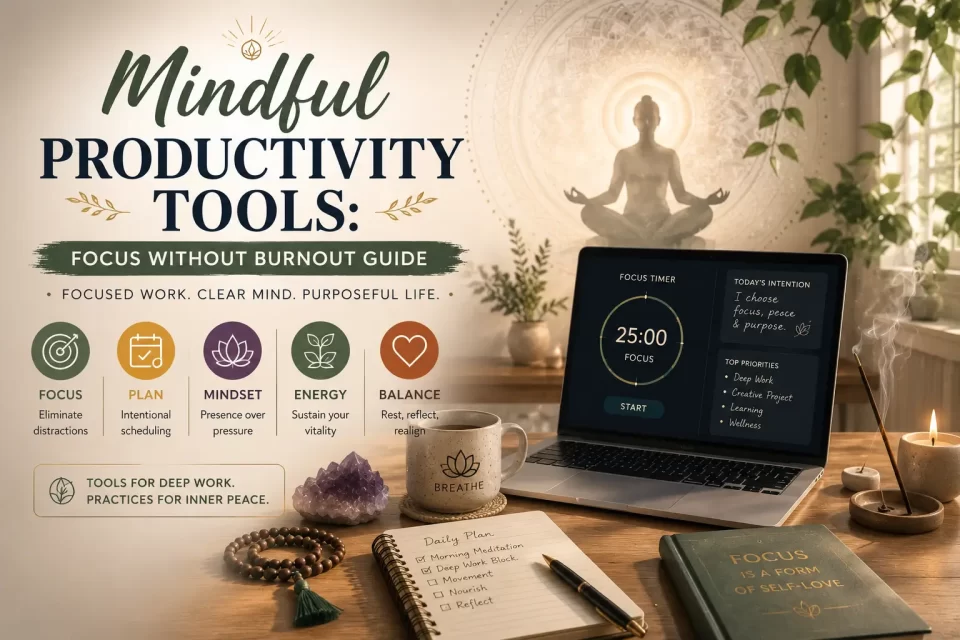
🌿 Introduction: The Productivity Paradox
Mindful productivity tools aren’t about doing more in less time. They’re about aligning your work with your values, protecting your energy, and cultivating presence amid demands. In an era of hustle culture, endless to-do lists, and burnout epidemics, many seekers ask: Can I be effective without exhausting my soul?
This article explores mindful productivity tools—the intentional integration of time management, focus strategies, and contemplative wisdom. Whether you’re overwhelmed by tasks, struggling with distraction, or simply seeking more meaning in your work, you’ll find grounded, values-aligned guidance here. You’ll learn how to work with your natural rhythms, prioritize what truly matters, and create space for both achievement and rest.
⚠️ Disclaimer: This article explores productivity practices for educational and reflective purposes. It is not a substitute for clinical therapy or occupational health guidance. If work-related stress significantly impacts your well-being, please consult a qualified mental health professional.
🔍 What Are Mindful Productivity Tools?
Mindful productivity tools are practices, systems, and technologies designed to support focused, values-aligned work—without depleting your energy or compromising your well-being. Unlike conventional productivity advice, which often emphasizes output maximization, mindful productivity centers intention, sustainability, and inner alignment.
This approach draws from:
- Contemplative traditions: Right effort (Buddhism), non-attachment to results (Bhagavad Gita), sacred work (monastic traditions)
- Neuroscience: Attention regulation, flow state research, cognitive load theory
- Ethical design: Human-centered tools, value-sensitive technology, digital minimalism
- Psychology: Habit formation, motivation science, boundary-setting
The core question of mindful productivity tools isn’t “How can I get more done?” but “How can I work in a way that honors my whole self?” It’s not about grinding harder—it’s about working wiser. When you align your methods with your values, productivity becomes an expression of purpose, not a source of pressure.
💡 Why This Approach Matters Now More Than Ever
We live in an age of unprecedented work complexity: remote collaboration, constant connectivity, and blurred boundaries between personal and professional life. Many high-achievers feel successful on paper yet exhausted, fragmented, or disconnected from what truly matters.
Mindful productivity tools offer a different path. They invite you to:
- Work with your rhythms: Honor natural energy cycles instead of fighting them
- Prioritize with purpose: Focus on what aligns with your values, not just urgency
- Protect your attention: Treat focus as a sacred resource, not an infinite commodity
- Integrate rest as strategy: Recognize that renewal fuels sustainable performance
Modern work culture often glorifies busyness, multitasking, and perpetual availability. Mindful productivity tools gently return us to agency. They remind us that true effectiveness isn’t measured by output alone—it’s measured by alignment, impact, and well-being. As author Cal Newport notes: “Depth is the new superpower.” Source: Deep Work
🔬 The Science of Focus & Flow
You might wonder: Is mindful productivity tools just philosophy, or does research support this approach? Growing evidence from neuroscience, psychology, and organizational science affirms its value.
Attention Regulation & Cognitive Performance
The brain’s prefrontal cortex manages focus, decision-making, and impulse control. Research shows that multitasking reduces cognitive performance by up to 40% and increases error rates. Stanford University studies confirm that single-tasking with intentional breaks enhances both quality and sustainability of work.
Flow State & Optimal Experience
Psychologist Mihaly Csikszentmihalyi defined “flow” as a state of complete absorption in meaningful activity. Flow correlates with higher creativity, satisfaction, and performance. Practices that support mindful productivity tools—like clear goals, immediate feedback, and challenge-skill balance—cultivate flow more reliably than pressure or deadlines alone. Research from Claremont Graduate University documents how intentional work design triggers flow.
Circadian Rhythms & Energy Management
Your body operates on natural energy cycles influenced by light, sleep, and activity. Working against these rhythms (e.g., deep focus tasks during post-lunch slumps) reduces effectiveness. Aligning tasks with your chronotype—your natural peak energy times—enhances both output and well-being. Harvard Medical School confirms that circadian alignment is a powerful, free productivity lever.
Rest, Recovery & Neural Consolidation
Rest isn’t laziness—it’s biological necessity. During downtime, the brain consolidates learning, processes emotions, and generates creative insights. National Institutes of Health research shows that strategic breaks improve memory, problem-solving, and emotional regulation.
Understanding these mechanisms transforms mindful productivity tools from abstract ideal to embodied practice. You’re not just “managing time”—you’re stewarding your energy, attention, and purpose.
🧭 5 Principles of Conscious Productivity
Understanding mindful productivity tools means embodying these guiding truths in daily work:
1. Intention Before Action
Before starting a task, pause. Ask: “Why does this matter? Does it align with my values—or just my to-do list?”
Why it works: Prevents autopilot work, aligns effort with purpose, reduces decision fatigue.
2. Depth Over Distraction
Protect blocks of uninterrupted time for meaningful work. Close notifications, silence alerts, and create physical or digital boundaries.
Why it works: Enables flow state, improves output quality, reduces cognitive switching costs.
3. Rhythms Over Rigidity
Work with your natural energy cycles, not against them. Schedule demanding tasks during peak focus times; reserve low-energy periods for admin or rest.
Why it works: Honors your biology, prevents burnout, supports sustainable performance.
4. Completion Over Perfection
Done is better than perfect. Ship work that serves, then iterate. Perfectionism often masks fear—not excellence.
Why it works: Reduces procrastination, builds momentum, fosters learning through action.
5. Rest as Strategy
Schedule renewal intentionally: short breaks, tech-free transitions, and true downtime. Rest isn’t a reward for productivity—it’s a prerequisite.
Why it works: Supports neural recovery, prevents decision fatigue, sustains long-term effectiveness.
⚠️ Common Productivity Traps & Solutions
Even well-intentioned workers encounter challenges. Recognizing these traps keeps your use of mindful productivity tools aligned and sustainable:
🔸 The Hustle Trap
Believing that more hours = more value.
Solution: Measure impact, not hours. Ask: “Did this work move what matters forward?”
🔸 The Tool Trap
Collecting apps and systems without implementing any deeply.
Solution: Choose 1-2 tools. Master them for 30 days before adding more.
🔸 The Comparison Trap
Measuring your productivity against someone else’s highlight reel.
Solution: Honor your unique rhythm. Your journey is valid exactly as it unfolds.
🔸 The Spiritual Bypass Trap
Using “mindfulness” to avoid setting necessary boundaries or having difficult conversations.
Solution: Pair contemplative practices with concrete action. Awareness without change is incomplete.
🔸 The Burnout Trap
Pushing through exhaustion until your body forces rest.
Solution: Schedule renewal proactively. Listen to early signals: irritability, brain fog, sleep disruption.
Awareness dissolves these patterns. When you notice the trap, you’ve already stepped out of it.
🛠️ 7 Mindful Productivity Tools to Try Today
Theory becomes transformation through practice. Try these simple, research-aligned mindful productivity tools in daily work:
🔹 The “Why This, Why Now?” Pause (1 Minute)
Before starting a task, pause for one breath. Ask silently: “Why does this matter? Why now?” If unclear, defer or delegate.
Why it works: Activates prefrontal discernment, aligns action with values, prevents reactive work.
🔹 Time Blocking with Energy Mapping (Weekly Planning)
Schedule tasks based on your natural energy rhythms: deep work during peak focus, admin during lower-energy windows. Use a simple calendar or planner.
Why it works: Aligns work with biology, reduces friction, enhances flow potential.
🔹 The Pomodoro Technique + Mindful Transitions (Daily Focus)
Work in 25-minute focused sprints followed by 5-minute mindful breaks (stretch, breathe, look away from screens). After four cycles, take a 15-30 minute rest.
Why it works: Prevents cognitive fatigue, sustains attention, builds sustainable rhythm. Research on ultradian rhythms supports this approach.
🔹 Digital Minimalism for Work Tools (Environment Design)
Audit your work apps and tools. Keep only what serves your core values. Uninstall or hide distractions. Create a clean, intentional digital workspace.
Why it works: Reduces decision fatigue, minimizes distraction, clarifies priorities.
🔹 The “Done for Today” Ritual (Evening Closure)
At day’s end, review: “What moved forward? What can wait?” Write tomorrow’s top 3 priorities. Then consciously close work: shut laptop, tidy space, transition ritual.
Why it works: Prevents work bleed into personal time, supports restorative rest, builds completion mindset.
🔹 Single-Tasking with Full Attention (During Work)
When working on a task, close unrelated tabs, silence notifications, and give it your full attention. If distracted, gently return—without self-judgment.
Why it works: Enhances quality, reduces errors, cultivates presence in action.
🔹 Weekly Reflection & Adjustment (Sustainable Growth)
Once weekly, reflect: “What worked? What drained me? What will I adjust?” Journal briefly without judgment. Adjust systems, not self-worth.
Why it works: Consolidates learning, prevents burnout, supports intentional evolution.
💡 Implementation tip: Anchor one tool to an existing habit (morning planning, post-lunch reset, evening shutdown). Consistency > intensity.
📅 Your 14-Day Focus Reset Protocol
Sustainable use of mindful productivity tools thrives on gradual integration. Use this flexible framework to build lasting habits without overwhelm:
Week 1: Awareness & Intention
- Days 1-7: Practice “Why This, Why Now?” pause before each work session
- Track energy levels (not just time) without judgment
- Journal one sentence nightly: “Today my work felt most aligned when…”
Week 2: Systems & Boundaries
- Days 8-14: Implement time blocking + Pomodoro technique
- Create one digital minimalism boundary (e.g., close all tabs except current task)
- Add evening “Done for Today” ritual
- Reflect weekly: What feels expansive? What feels forced? Adjust accordingly
This protocol isn’t a performance test. It’s a conversation with your energy. If a day feels heavy, simplify. If a practice feels expansive, deepen it. Mindful productivity tools honor your unique pacing.
🛡️ Creating Sustainable Work Boundaries
Boundaries aren’t restrictions—they’re protections for what matters. Use these guidelines to create mindful productivity tools boundaries that stick:
🔹 Start Small, Build Momentum
Choose one boundary to implement for 7 days before adding another. Example: “No email after 6 PM” before tackling “No work on Sundays.”
🔹 Make Boundaries Visible
Place visual reminders: a sticky note on your monitor (“Why this, why now?”), a calendar block for focus time, or a phone wallpaper with your intention.
🔹 Communicate Your Boundaries
Share your work intentions with colleagues or clients. Example: “I’m practicing focused work blocks to deliver higher quality. I’ll respond to messages during designated times.”
🔹 Build in Flexibility
Work isn’t rigid. Allow exceptions for emergencies, deadlines, or collaboration. The goal is conscious choice, not perfection.
🔹 Review & Adjust Monthly
At month’s end, reflect: Which boundaries felt supportive? Which felt restrictive? Adjust based on lived experience, not rigid rules.
Boundaries supported by self-compassion become sustainable. Boundaries enforced by self-criticism become burdens.
⚠️ When Productivity Becomes Obsession
Even healthy practices can become compulsive. Watch for these signs that mindful productivity tools have shifted into obsession:
- Checking task lists compulsively, even during rest
- Feeling anxious when not “producing”
- Using productivity systems to avoid emotional processing
- Comparing your output to others’ metrics
- Sacrificing relationships, health, or joy for “efficiency”
If you notice these patterns:
- Pause and breathe
- Ask: “Is this serving my humanity—or my ego?”
- Reconnect with your values: “What truly matters right now?”
- Seek support if needed: therapist, coach, or trusted community
True productivity serves life—it doesn’t replace it.
📊 Tracking Progress Without Pressure
Measurement supports mindful productivity tools when used wisely. When it becomes compulsive, it backfires. Use these guidelines to track mindfully:
- Choose qualitative reflection over metrics: Journal how you feel, not just tasks completed. Notice shifts in ease, focus, or alignment.
- Review weekly, not daily: Daily fluctuations are normal. Weekly patterns reveal truth.
- Celebrate non-linear progress: Growth isn’t a straight line. Plateaus and dips are part of integration.
- Drop what hurts: If tracking increases anxiety or self-judgment, pause. Return to body-based awareness.
- Honor subtle shifts: Sometimes the deepest changes are quiet: a quicker return to focus after distraction, a deeper breath before starting a task.
Tools like simple notebooks, voice memos, or gentle apps work best. Avoid platforms that gamify productivity or trigger comparison. Your worth isn’t a leaderboard.
❓ Frequently Asked Questions
Q: Are mindful productivity tools just for entrepreneurs or knowledge workers?
A: Not at all. The principles apply to any work: parenting, caregiving, creative projects, or community service. Start where you are. Use what you have.
Q: How long until I notice changes?
A: Subtle shifts in focus and ease often appear within 1-2 weeks. Deeper integration—like sustainable rhythms or clearer priorities—typically stabilizes by week 3-4. Neural and behavioral rewiring deepens over 2-3 months. Patience is part of the practice.
Q: Can I combine mindful productivity with my spiritual practice?
A: Absolutely. Many find that intentional work deepens contemplative practice—and vice versa. They’re complementary pathways to presence, not competing disciplines.
Q: What if my job requires constant reactivity?
A: Focus on micro-boundaries: one-screen rule, intentional transitions, brief mindful pauses between tasks. Even small shifts create meaningful impact.
Q: How do I handle pressure to be “always on”?
A: Communicate your boundaries with kindness: “I’m practicing focused work blocks to deliver higher quality. I’ll respond to messages during designated times.” True collaboration respects sustainable rhythms.
Q: What’s one simple step I can take today?
A: Before your next task, pause for one breath. Ask: “Why this, why now?” Listen. That’s mindful productivity tools in action. No cost. No complexity. Just presence meeting purpose.
🙏 Conclusion: Productivity as Presence
Here’s the quiet truth worth carrying:
You are not a machine to optimize. You are a life to express.
Exploring mindful productivity tools isn’t about collecting systems or achieving perfect efficiency. It’s about returning home to yourself—with curiosity, compassion, and courage. When intention meets action, work becomes worship.
Let wisdom inform your methods. Let kindness guide your boundaries. And let presence be your ultimate productivity hack. The path isn’t about doing more. It’s about being more—fully, freely, faithfully—in everything you do. Read More
💬 What resonates with you?
• Which principle shifted your view of productivity today?
• Which tool will you try this week?
• What questions remain about conscious work?Share your reflection below—or email
rrrcontact@iamrrr.in. Your voice deepens this community. 🙏
✨ If this guide supported your journey, consider:
• 📧 Joining our Weekly Wisdom newsletter for exclusive reflections + printable focus templates
• 💙 Supporting this work via roshopion to keep wisdom freely accessible
• 🔄 Sharing with one friend navigating work with more presence
With gratitude for your mindful engagement,
Rajesh Ramdev Ram
iamrrr.in | Spiritual Psychology & Conscious Living
